Mold Making
Engineering & DFM | Reduce Tooling Risk Before Steel Is Cut
Practical DFM review for manufacturability, warpage, cooling, venting, assembly fit, and production stability—before tooling investment begins.
Most tooling problems are not discovered when the mold is quoted. They are discovered later—during the T0 or T1 trial, during assembly validation, or after production instability starts to appear. By that point, fixes are already more expensive, slower, and harder to implement.
At Jeancen Mold, our Engineering & DFM review helps product development, engineering, and sourcing teams identify tooling, molding, and assembly risks before steel is cut. The goal is not only to make a mold buildable, but to make it manufacturable, practical to maintain, and stable in production.
Built on mold manufacturing experience dating back to 2011, and supported by Engineering Director Lin's 12+ years of mold design experience, we approach DFM as an engineering decision process, not just a quotation step.
What We Review Before Steel Cut
Our DFM review focuses on the practical issues that affect mold feasibility, molding performance, assembly fit, cosmetic quality, and long-term production stability.
Key review points include:
- Wall thickness consistency and sink-risk areas
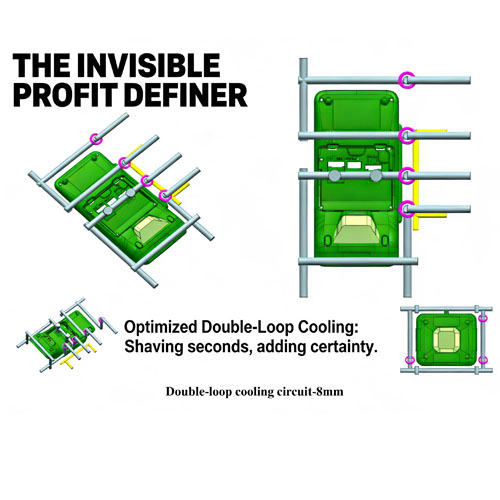
- Cooling logic and likely warpage zones
- Gate position, filling balance, and flow path feasibility
- Venting needs in deep ribs, shut-offs, and tight features
- Ejection strategy and cosmetic mark risk
- Undercuts, sliders, lifters, and parting line feasibility
- Tolerance stack-up and assembly-fit risk
- Insert positioning, anti-shift logic, and overmolding feasibility
- Serviceability, replaceable wear areas, and maintenance access
Where appropriate, our engineering review may also consider mold flow direction, structural reinforcement logic, optical or cosmetic sensitivity, and production repeatability risks.
Our goal is not only to confirm that a mold can be built, but to help ensure that it can run reliably in production.
Why Engineering & DFM Matter in Tooling Projects
A tooling problem rarely starts at T0. In many projects, the real issue starts much earlier—during part design review, tooling logic decisions, or incomplete manufacturability evaluation.
A proper DFM review helps reduce the risk of:
- Warpage and unstable dimensions
- Sink marks, short shots, and poor filling balance
- Flash on cosmetic edges or difficult shut-offs
- Gate vestige issues on visible surfaces
- Assembly mismatch and tolerance-related fit problems
- Difficult demolding or ejector mark risk
- Insert movement during molding
- Maintenance-heavy tooling with poor long-term serviceability
For NPI tooling projects, solving these issues early often means fewer revisions, faster validation, and a smoother path from T0/T1 to mass production.
Our Engineering Mindset
At Jeancen Mold, DFM is not treated as a checklist exercise alone. We review each project with a production mindset.
That means we look beyond "can it be molded?" and also ask:
- Will this design stay stable over repeated production cycles?
- Will the mold be practical to machine, assemble, trial, and maintain?
- Will cooling and ejection logic support repeatability?
- Will the tooling be easy to service when wear occurs?
- Will this decision reduce the long-term cost of ownership, not only the mold price?
This is where many standard DFM reviews stop too early. We look not only at molding feasibility, but also at assembly logic, maintenance requirements, and the long-term tooling decisions that affect stable production.
Typical Applications We Support
Our Engineering & DFM review is especially valuable for projects with tighter technical requirements, higher assembly sensitivity, or more demanding production expectations.
Typical applications include:
- Automotive lighting and optical molded parts
- Electrical and electronic housings
- Insert-molded functional parts
- Tight-tolerance structural components
- Transparent or cosmetic plastic parts
- 2K / bi-injection components
- Industrial plastic parts requiring stable fit and repeatability
- New Product Introduction (NPI) projects requiring faster validation
This makes our DFM support especially relevant for teams developing functional housings, insert-molded assemblies, optical components, and other parts where appearance, structure, and manufacturability must work together.
What Customers Receive from Our DFM Review
Depending on project stage and complexity, our support may include both risk identification and practical tooling direction.
Typical deliverables include:
- Initial DFM comments and manufacturability feedback
- Tooling feasibility suggestions before quotation
- Risk identification for warpage, cooling, venting, and fit-up
- Recommendations for gating, ejection, or insert logic
- Mold design direction aligned with production stability
- Faster engineering communication during early-stage project review
For selected projects, we may also support deeper technical review related to mold structure logic, material selection direction, tolerance-sensitive areas, or validation priorities before tooling release. DFM or validation reports can be provided according to customer requirements and the agreed project scope.
For many customers, this early feedback helps avoid unnecessary iteration and supports better tooling decisions before investment is committed.
What We Need to Start a DFM Review
To provide a practical and efficient Engineering & DFM review, it helps if you can share the following project information:
- 3D files (STEP, STP, IGES, IGS, or X_T preferred)
- 2D drawings or reference files (PDF; ZIP packages accepted)
- Resin or material information
- Critical dimensions or fit requirements
- Appearance requirements for visible surfaces
- Expected annual volume or pilot-run target
- Known assembly, sealing, or insert-related concerns
Even if your design is still at an early stage, we can usually provide a first-pass review and identify the main tooling risk areas.
Start Your Engineering & DFM Review
If you are evaluating a new tooling project, send us your 3D file or concept drawing. We can review the main tooling, molding, and assembly risks before steel is cut and help you move toward a more stable mold solution. NDA is available before quotation. After receiving suitable project information, we provide an initial response within 24 hours; detailed DFM scope depends on the project stage and available data.
Related Pages