Jun 26, 2026Sourcing Guide & Costs
Family Mold vs. Separate Tools: When Does Combining Parts Actually Save Money?
Anyone involved in plastic product development, sourcing, or production planning has probably heard this idea before: if several different parts can be combined into one mold, it must be cheaper than
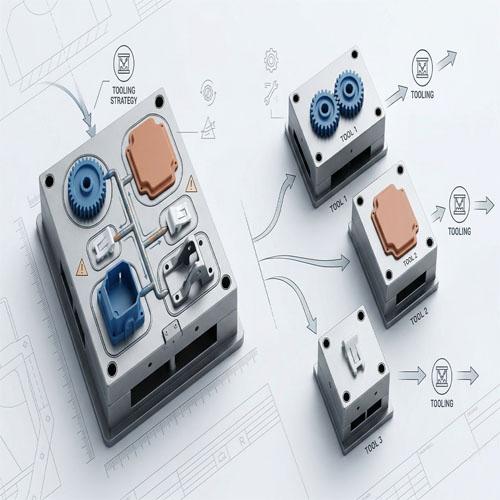
Anyone involved in plastic product development, sourcing, or production planning has probably heard this idea before: if several different parts can be combined into one mold, it must be cheaper than building separate tools.
At first glance, that sounds reasonable. After all, a single injection mold already carries a high upfront cost — from mold design and steel selection to machining and mold trials. If multiple parts can share one mold base, it seems like a direct way to reduce duplicate tooling investment.
But in real injection mold projects, combining different parts into one mold is not automatically the cheaper option.
In the right situation, a family mold can reduce upfront tooling cost and simplify production planning. In the wrong situation, it can increase mold complexity, reduce production flexibility, raise maintenance exposure, and create higher total cost over time.
This article explains when a family mold genuinely saves money, when separate tools are the better decision, and how to evaluate the trade-off before steel is cut.
1. What Is a Family Mold?
A family mold is an injection mold that produces two or more different part geometries within a single mold base.
This is different from a standard multi-cavity mold, where each cavity produces the same part. In a family mold, the cavities are different parts, often designed to be used together in the same product assembly.
The appeal is clear:
- Fewer mold bases
- Less duplicated tooling infrastructure
- Potentially lower upfront tooling investment
- Easier synchronized production for matched component sets
However, the economic result depends entirely on whether those parts are truly compatible from a tooling and production standpoint.
2. When a Family Mold Genuinely Saves Money
A family mold is most likely to deliver a cost advantage when it reduces duplicated fixed costs without introducing major tooling or production penalties.
2.1 Parts Have Similar Geometry, Material, and Process Requirements
The best family mold candidates usually share similar projected area, similar wall thickness, the same resin and color, the same mold opening direction, and no unique side actions, lifters, or complex undercuts for only one part.
When these conditions are met, the mold can often share the same mold base, runner design, cooling strategy, and ejection system. In that case, the additional cost is mainly in the cavity inserts rather than in building multiple complete tools. This is where a family mold can legitimately reduce tooling cost compared with separate tools.
Example: Three small appliance components — a top cover, a clip, and a push button — all in PP, all with simple geometry, similar wall thickness, and the same draft direction. In this type of project, combining them into one mold is often the practical choice.
2.2 Low-to-Medium Volume Across Multiple Part Numbers
If each individual part has relatively low demand, building a dedicated mold for every part may be difficult to justify. This is common in pilot production, low-volume market validation, customized product sets, and multiple SKUs with modest demand per item. In these cases, a family mold can compress the fixed tooling investment across several part numbers at once, improving the cost model of the program.
2.3 Assembly Components That Must Ship Together
A family mold can also make sense when the parts are always used as a matched set — for example, one housing element, one bracket, two clips, and one cover piece that are always required together. A family mold may help synchronize production and reduce scheduling mismatch between separate tools.
This can reduce machine changeovers, tool scheduling complexity, and inventory imbalance between matched components. In this kind of project, the savings do not come only from mold cost. They also come from simpler production coordination.
3. When a Family Mold Costs More Than Separate Tools
This is the part many buyers underestimate. A family mold may reduce the number of mold bases — but if the parts are not truly compatible, the engineering and production penalties can outweigh that saving.
3.1 When Parts Have Significantly Different Geometry or Process Requirements
If the parts have very different wall thickness, different draft directions, different side-action requirements, different shrink behavior, different cosmetic priorities, or different resin or color requirements, then each cavity begins to behave like its own mold inside a shared base.
That means the tool may require a more complex runner design, more difficult cooling layout, different ejection logic, more Moldflow iterations, and more mold trials to balance fill.
At that point, the family mold may become more expensive than the equivalent separate tools, not because the mold base is large, but because the engineering and machining complexity rises sharply. The apparent saving from "one mold instead of three" can disappear very quickly when incompatible parts are forced into the same tool.
3.2 When One Part Needs High Volume, and the Others Do Not
A family mold produces all cavities together, which means all parts come out in a fixed ratio. This becomes a problem when one part is a high-demand item while the other parts move much more slowly, or when future demand per SKU is not balanced.
In that situation, the production team is forced into one of two bad choices: overproduce the slow-moving parts just to keep up with the fast-moving ones, or slow down production of the high-demand part to match the others. Neither is efficient.
If one or more parts are expected to run at significantly higher volume than the rest, separate tooling usually gives much better long-term production flexibility.
3.3 When Future Maintenance or Design Changes Are Likely
A family mold is a shared dependency. If one cavity needs repair, dimensional correction, feature modification, texture change, or insert replacement, the entire mold may need to come out of production. That means a problem affecting one part can interrupt production of all parts in the family.
For short-life or stable projects, this may be acceptable. For products expected to evolve over time, family molds often create more maintenance exposure and more downtime risk than separate tools.
3.4 When Quality Consistency Is Difficult to Balance
Balanced fill is one of the biggest technical challenges in family mold design. If the cavities are not similar in volume, flow length, wall thickness, or gate location sensitivity, it becomes much harder to ensure that all parts fill correctly under the same molding window.
When fill is not well balanced, the result may be flash in one cavity, short shots in another, inconsistent shrinkage, dimensional variation, or cosmetic instability across different parts. For precision components or appearance-sensitive parts, this risk is especially important.
A family mold can absolutely work in demanding applications — but only when the fill balance and tooling logic are engineered correctly from the start.
4. Why the Cheapest Tool at the Quotation Stage Can Become the Most Expensive Choice Later
At the quotation stage, a family mold often looks attractive because it appears to reduce the number of tools. But tooling cost is only one part of the total project cost.
The real question is: what will this mold decision do to the project over the full production life?
A lower upfront mold quotation can later be offset by higher mold complexity, more trial iterations, lower production flexibility, higher inventory imbalance, more difficult maintenance, greater downtime exposure, and more quality balancing effort.
That is why family mold evaluation should never be based on mold price alone. The correct comparison is not just family mold cost versus separate mold cost. The correct comparison is upfront tooling investment, production flexibility, part balance over time, maintenance exposure, and long-term operating cost together. In many real projects, that broader view changes the decision completely.
5. A Practical 3-Step Framework for Deciding
If you want to make a practical decision before tooling starts, this three-step evaluation is usually the fastest way.
Step 1 — Evaluate Part Compatibility
Are the parts similar in size and wall thickness? Do they use the same material and color? Do they share the same mold opening direction? Do they require similar tooling logic? If yes, a family mold may be viable. If the parts are structurally very different, separate tools are usually safer.
Step 2 — Evaluate Production Volume
Is each part low-to-medium volume? Are the parts needed in similar quantities? Are all SKUs likely to move together? If the production demand is balanced, a family mold may improve economics. If one part is likely to become a high-volume runner while others remain slower, separate tools usually provide better long-term control.
Step 3 — Evaluate the Long-Term Roadmap
Is the product stable, or likely to change? Will some parts need independent revision later? Is flexibility more important than initial tooling reduction? If the product set is stable and the lifecycle is relatively short, a family mold may work well. If ongoing design changes, cavity-specific maintenance, or evolving product mix are expected, separate tools usually reduce long-term risk.
6. A Real Project Example
One of the more demanding family mold projects we have completed involved a 12-component mechanical timer assembly. The customer wanted to combine all 12 parts into a single family mold to reduce tooling investment, simplify production planning, and maintain assembly compatibility across the full component set.
The parts had different shapes, functions, and cosmetic requirements — which meant that standard runner sizing alone would not have been enough to ensure stable filling across all 12 cavities. The real engineering challenges were: balanced filling across cavities of different sizes, sharp debossed dial markings with a high-gloss surface finish, gate vestige control on visible components, and side through-holes requiring slider mechanisms.
Our approach started with a full DFM analysis before steel was cut. Runner dimensions and flow-control features were calculated through mold flow analysis. Gate types were selected per part based on cosmetic sensitivity — submarine gates for visible surfaces, edge gates for structural parts. A cavity-side core-pull mechanism was designed to handle the side holes cleanly in one molding cycle.
The outcome was a working family mold that produced all 12 parts with consistent fill, controlled cosmetic quality, and stable assembly fit — without the kind of trial-stage rework that often follows when these risks are not reviewed early.
This project is a good illustration of the main point in this article: the savings from a family mold do not come from simply combining parts into one tool. They come from solving the manufacturability risks early enough to support stable production later.
7. Four Common Misunderstandings About Family Molds
Misunderstanding 1: Fewer molds always mean lower cost.
A family mold can reduce duplicate mold-based cost, but it can also introduce engineering and production costs that separate tools would avoid.
Misunderstanding 2: If parts belong to the same product, they should go into one mold.
Being part of the same assembly does not automatically mean the parts are compatible from a tooling and production perspective.
Misunderstanding 3: Family molds are always better for small projects.
Only when the part set is compatible. If the geometries are too different, even a small-volume project may be better served by separate, simpler tools.
Misunderstanding 4: The decision is mainly about the tooling quotation.
The better decision usually comes from evaluating the full production logic — not just the mold price.
8. What Should Be Reviewed Before Making the Decision?
Before committing to a family mold strategy, it is better to review:
- Part geometry compatibility
- Resin and color consistency
- Cavity fill balance
- Gate locations
- Wall thickness variation
- Mold opening direction
- Expected annual volume per part
- Long-term SKU demand balance
- Maintenance and modification exposure
For many projects, it is also worth combining the decision with an Engineering & DFM review, Moldflow analysis, runner balance study, filling pressure evaluation, and assembly-fit review. This helps identify whether the apparent tooling saving is technically and commercially sustainable before steel is cut.
9. Final Thought: A Family Mold Is Not a Shortcut — It Is a Strategy
A family mold can be the right decision. It can also become an expensive compromise.
What matters is not whether multiple parts can physically fit into one mold. What matters is whether combining them creates a better production and cost outcome over the life of the project.
If the parts are compatible, the demand is balanced, and long-term flexibility is not heavily constrained, a family mold may reduce tooling investment and simplify coordinated production. If the parts are mismatched, the demand is uneven, or the product roadmap is likely to evolve, separate tools are often the more robust decision.
The right answer is usually found before tooling starts, not after the mold has already been built.
Need Help Evaluating Whether a Family Mold Makes Sense?
If you are currently evaluating whether several parts should be combined into one mold or separated into dedicated tools, we recommend reviewing the decision early.
Useful inputs include 3D files or part drawings, material information, annual volume by part number, assembly relationship between parts, cosmetic requirements, and future revision expectations. We can help review the compatibility, production logic, and tooling trade-offs before mold design is finalized.