Jun 26, 2026Sourcing Guide & Costs
Why Complex Plastic Parts Increase Tooling Cost: A Tooling Engineer's View
Complex plastic parts increase mold cost not because of size, but because of undercuts, machining difficulty, narrow process windows, and long-term maintenance risk. Learn what drives tooling cost bef
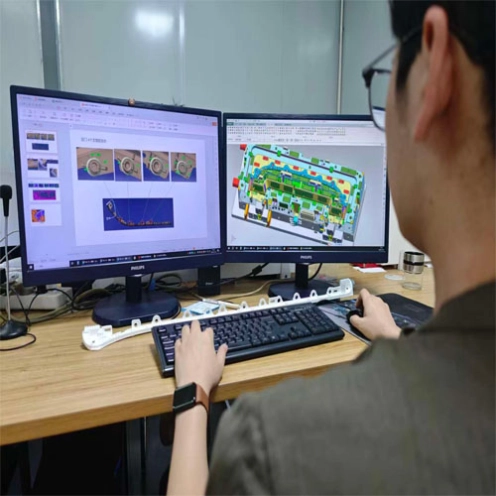
In plastic product development, a common situation appears again and again.
A part design looks good on the screen. It has a better appearance, more functions, tighter assembly features, and a more compact structure. But when the part reaches the tooling review stage, the mold cost increases much more than expected.
From the customer side, it may feel like the mold supplier is making the project expensive. But from a tooling engineering perspective, the cost increase usually comes from something very practical: every extra feature may create extra mold structure, machining work, trial risk, and long-term maintenance cost.
A plastic part is not expensive to tool only because it looks complex. It becomes expensive when the structure creates risks that the mold must solve.
At Jeancen Mold, our senior tooling engineer reviews these areas carefully when a plastic part design becomes more complex.
1. More Undercuts Usually Mean More Mold Actions
A simple plastic part can often be produced with a basic two-plate or three-plate mold. But once the part has side holes, internal clips, hooks, deep pockets, complex shut-offs, thread features, or hidden assembly structures, the mold can no longer open and release the part in a simple direction.
Then the mold may need sliders, lifters, core pulls, angled mechanisms, unscrewing mechanisms, or complex insert combinations. Each mold action adds more than one component — it adds design work, machining work, fitting work, moving parts, wear areas, and possible failure points during production.
This is one reason why two plastic parts with similar size and weight can have very different mold costs. The part size may be similar, but the mold logic can be completely different.
2. Complex Geometry Increases Machining Difficulty
A mold is not only designed in 3D. It must be machined, fitted, polished, assembled, and tested.
For a simple part, the mold may be mostly finished by standard CNC machining, drilling, EDM, and polishing. For a complex part, more machining processes may be required: high-precision CNC, slow wire-cut EDM, sinker EDM, mirror EDM, grinding, hand fitting, local polishing, and insert matching.
The more complex the product geometry is, the more difficult it becomes to keep steel strength, machining accuracy, and assembly fit at the same time. Some areas may look small in CAD, but they may be very difficult to cut in steel. A thin rib, a deep slot, a sharp internal corner, or a narrow shut-off can create many hours of additional tooling work.
This is why mold cost is not only calculated from part size. It is also calculated from the machining risk.
3. More Inserts May Be Needed for Venting, Machining, and Maintenance
Insert design is often misunderstood. Some people think inserts only make the mold more complicated. But in many cases, inserts are used to reduce risk.
For example, inserts may be needed when deep ribs need better venting, local steel is too thin, a feature is difficult to machine from one solid block, a local area may need adjustment after T0, a wear area needs future replacement, or a cosmetic surface risk needs to be controlled.
A good insert layout can make the mold easier to machine, easier to vent, easier to repair, and easier to maintain. But too many inserts can also increase fitting work, parting line risk, flash risk, and maintenance complexity.
So, the insert design is not a template decision. It requires practical judgment. The question is not "should we use inserts or not?" The real question is: where do inserts reduce risk, and where do they create new risk?
4. Complex Parts Often Have a Narrower Molding Process Window
A simple part with uniform wall thickness and a clean flow path is usually easier to process. A complex part is different.
It may have uneven wall thickness, dense ribs, long flow length, thin-wall areas, deep bosses, multiple shut-off areas, cosmetic surfaces near structural features, areas that trap air, or features that resist ejection. These conditions can make the molding process window much narrower.
A small change in injection speed, holding pressure, mold temperature, or cooling time may affect the final result — short shot, sink marks, flash, warpage, burn marks, weld line weakness, drag marks, sticking, or dimensional variation.
In this situation, the mold does not only need to "make the part." It needs to make the part repeatedly under stable production conditions. That requires better cooling, venting, gating, ejection, steel selection, and trial planning.
5. Trial and Correction Risk Becomes Higher
No tooling engineer should assume that a complex mold will be perfect after the first trial. T0 is only the first time the part design, mold steel, plastic material, injection process, and real assembly condition meet together.
For complex plastic parts, T0 may expose problems that were not obvious in the CAD model — local filling difficulty, unexpected sink marks, tight or loose assembly fit, flash around moving structures, ejection marks, deformation after cooling, cosmetic surface issues, or part sticking on the core or slider.
Each correction takes time. The mold may need welding, re-machining, polishing, insert modification, gate adjustment, venting improvement, or process revalidation.
This is why early DFM review is important. A small discussion before steel cutting is usually much cheaper than a large correction after T0.
6. Long-Term Maintenance Cost Can Be Higher Than Expected
Tooling cost does not end when the mold is delivered. A mold must run. And the more complex the mold structure is, the more attention it usually needs during production.
Moving components such as sliders, lifters, core pulls, ejector pins, blades, sleeves, and special inserts all need stable movement and proper maintenance. Over time, complex molds may face wear on moving surfaces, broken or bent pins, parting line flash, slider movement issues, lifter galling, cooling channel blockage, ejection imbalance, or longer downtime for repair.
This is why mold design should consider maintenance from the beginning. A good mold should not only produce acceptable samples — it should be practical to service, repair, and keep stable during repeated production.
Complexity Is Not Always Bad
At Jeancen Mold, we do not believe plastic parts should always be as simple as possible. That would not be realistic.
Many complex features are necessary. A product may need clips, hooks, sealing surfaces, screw bosses, ribs, snap fits, optical surfaces, assembly locators, or compact internal structures. These features may be important for function, appearance, strength, or user experience.
So the goal is not to remove all complexity. The goal is to make sure every complex feature has a clear reason.
Before steel cutting, our engineering team typically asks:
- Does this feature support a real function?
- Can the same function be achieved with a simpler structure?
- Will this area create an undercut?
- Will it require a slider, lifter, or insert?
- Will it increase machining difficulty?
- Will it affect ejection?
- Will it create a sink mark or warpage risk?
- Can it be maintained during production?
- Is the customer aware of the tooling impact?
These questions help both the product team and tooling team make better decisions early.
Final Thought
When a plastic part becomes more complex, the mold cost does not rise only because the supplier wants a higher price. It rises because the mold has to solve more problems — more mold actions, more machining steps, more fitting work, more trial risk, more maintenance points, and a narrower process window.
A good tooling review is not about saying "no" to complex designs. It is about helping the product team understand which features are worth the cost, which features can be simplified, and which risks should be solved before steel is cut.
The best time to reduce mold cost is not after receiving the quotation. It is during the product design and DFM stage. That is where many expensive tooling decisions are already being made.