Jun 26, 2026Technical Case Studies
Case Study: PA66+30%GF Nylon End Cap DFM Before Tooling Build
A heavy-duty nylon part used in a wet environment should not be treated as a simple "build the mold and test later" project. In this case, Jeancen helped an Australian hardware customer reduce materia
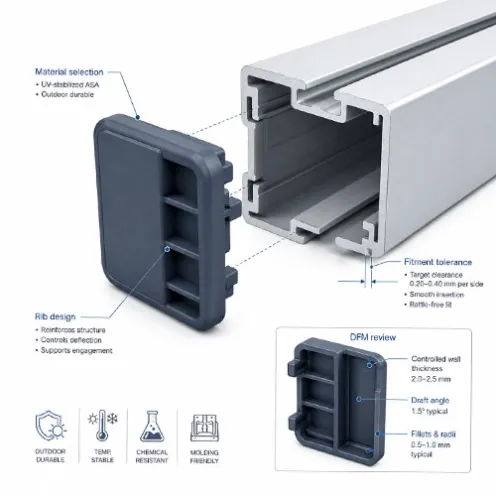
A heavy-duty nylon part used in a wet environment should not be treated as a simple "build the mold and test later" project. In this case, Jeancen helped a client reduce material, fit, and tooling risk before mold build for a sliding-fit nylon end cap. The project required early engineering decisions around resin family, glass fiber direction, moisture-related dimensional change, and DFM optimization before steel was cut.
Project Background
The customer was developing a heavy-duty molded end cap for an outdoor application exposed to a wet environment. The part also involved a sliding-fit function, so the material decision had to balance strength, wear behavior, and dimensional stability rather than focusing on nominal strength alone. At the beginning of the project, the customer was still evaluating whether PA6 would be sufficient or whether PA66 would be a safer long-term choice.
Project Specs
- Application: Heavy-duty nylon end cap for outdoor use
- Final Material Direction: PA66 + 30% GF
- Core Material: S136 Heat Treated
The core engineering challenges included balancing stiffness with dimensional stability in humidity, narrowing the right GF range without overcommitting too early, and ensuring the part would remain practical to mold in mass production without creating sink or ejection problems later.
Why PA66 Was Recommended Over PA6
Based on the product function and environmental exposure, Jeancen recommended PA66 over PA6. The logic was not based on material preference alone. It was based on long-term engineering fit for the application.
Compared with PA6, PA66 offered:
- Higher mechanical strength and stiffness
- Better creep resistance
- Higher melting point and thermal stability
- Lower moisture absorption and better dimensional stability in wet conditions
PA66 may carry a higher material cost depending on market conditions, but in this case the performance trade-off was more important than minimizing resin cost too early.
Moisture Expansion Was Evaluated Before Tooling
This was one of the most valuable parts of the engineering discussion. Instead of relying only on generic datasheet statements, Jeancen estimated the actual dimensional effect of moisture absorption.
The case data showed that PA66 typically has an equilibrium moisture absorption of about 2.1% to 2.6%, which may lead to approximately 0.25% dimensional expansion, depending on grade and GF content. For the customer's critical 28.15 mm sliding-fit dimension, that meant roughly 0.07 mm of possible growth. This kind of early understanding makes it possible to manage fit risk in tooling and validation, instead of discovering the issue only during assembly testing.
GF Validation Strategy Before Tool Commitment
Once PA66 was chosen as the base resin family, the next question was the right glass fiber direction. Instead of pretending there was one "perfect" answer from the start, Jeancen recommended a practical validation path.
Two sample material options were prepared for customer testing:
- PA66 + 15% GF
- PA66 + 30% GF
This allowed the customer to compare real assembly and performance behavior rather than making the decision only from material tables. After testing, the customer selected PA66 + 30% GF as the final material direction.
This part of the case matters because many projects lose time by locking material direction too early, before fit and use conditions are properly validated.
DFM Optimization Before Tooling
Once the final material direction was confirmed, Jeancen continued with proactive DFM work to reduce molding and tooling risk before mold build. The objective was not just to make the part moldable once, but to improve production stability and reduce later correction risk.
Functional Surface and Draft Strategy
Draft angle modifications were applied to the part, while critical mating and interfacing surfaces were intentionally preserved where functional fit required it. This helped preserve sliding-fit performance without weakening overall manufacturability.
Thick-Wall Risk Control
The wall thickness analysis showed an average thickness of 2.0 mm and a maximum thickness of 2.5 mm in one structurally important area. That thick section could not simply be hollowed out, because the part still needed the required strength. Instead, the sink-risk control strategy was shifted into process planning: extended packing time and increased packing pressure were planned to compensate for the thicker mass.
This is the kind of DFM decision that matters commercially. Removing mass too aggressively can weaken the part. Ignoring the section can create surface risk. This case shows a more balanced engineering choice.
Ejection Safety Optimization
Because this was a glass-fiber-reinforced nylon part, balanced ejection was critical. Unstable ejection could lead to stress marks, part damage, or production instability. Jeancen introduced two specific DFM improvements:
- A 0.2 mm chamfer at the bottom edge was removed to increase the available contact area for ejector blade placement
- A circular reinforcing rib was added to accommodate ejector sleeve placement while maintaining structural integrity
These are small geometric adjustments, but they directly improve production robustness.
Grip Surface Optimization
To improve clamping performance during assembly, Jeancen recommended applying texture to the clamping surfaces on both sides. This was intended to increase friction and reduce slip risk during use.
This is another good example of why DFM should not be treated as only a moldability checklist. It also affects functional use and assembly behavior.
Result and Engineering Value
This project was not just about choosing a nylon grade. It was about helping the customer make safer engineering decisions before tooling was built.
By recommending PA66 over PA6, validating the GF direction through sample testing, evaluating moisture-related dimensional growth early, and improving the DFM around thick walls, ejection, and grip surfaces, Jeancen helped turn the project into a more stable, production-ready tooling direction.
This case matters for buyers working on:
- Wet-environment functional parts
- Sliding-fit nylon components
- PA66 / GF material validation
- Projects where fit, tooling, and manufacturability must be aligned before mold build
Related Pages
Need DFM Support for a Nylon Functional Part?
If you are working on a nylon component where moisture, fit, GF ratio, ejection safety, or thick-wall control matters, it is better to review the risk before steel is cut.
Send Jeancen your drawing or project details for a practical DFM review.