Jun 26, 2026Sourcing Guide & Costs
How Mold Steel Selection Affects Tool Life, Maintenance, and Project Cost
When customers compare mold quotations, one common question is: Why does one supplier recommend P20, while another suggests H13, 1.2316, or S136? The answer is simple: Mold steel selection affects muc
When customers compare mold quotations, one common question is:
Why does one supplier recommend P20, while another suggests H13, 1.2316, or S136?
The answer is simple:
Mold steel selection affects much more than the initial mold price.
A lower-cost steel may reduce upfront tooling cost, but the wrong choice can increase maintenance, shorten tool life, and create instability in production.
It influences:
- Expected tool life
- Wear resistance
- Corrosion resistance
- Polishing performance
- Mold maintenance frequency
- Production stability
- Long-term total cost
That is why mold steel should never be selected by ranking alone.
The right choice depends on the resin, part design, surface requirement, annual volume, and maintenance expectations.
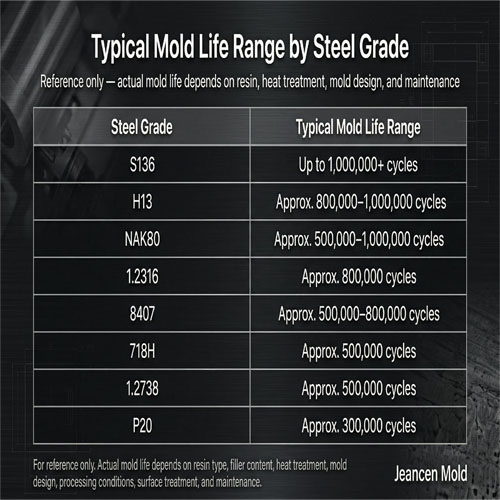
Typical Mold Life Range by Steel Grade
Below is a practical reference used in many injection mold projects.
Steel Grade | Typical Mold Life Range |
|---|---|
S136 | Up to 1,000,000+ cycles |
H13 | Approx. 800,000–1,000,000 cycles |
NAK80 | Approx. 500,000–1,000,000 cycles |
1.2316 | Approx. 800,000 cycles |
8407 | Approx. 500,000–800,000 cycles |
718H | Approx. 500,000 cycles |
1.2738 | Approx. 500,000 cycles |
P20 | Approx. 300,000 cycles |
Note: These ranges are for reference only. Actual mold life depends on resin type, filler content, heat treatment, mold design, cooling, processing conditions, surface treatment, and maintenance.
Why Mold Life Cannot Be Judged by Steel Grade Alone
Many people assume that a higher-grade steel automatically means a better mold.
In practice, actual tool life is strongly affected by several factors.
1. Resin Type
Different plastics create very different wear and corrosion conditions inside the mold.
For example, glass-filled materials usually create higher abrasion, while some resins may require better corrosion resistance.
2. Heat Treatment Quality
Even good steel can underperform if heat treatment is not properly controlled.
Hardness, toughness, and internal stability all affect long-term mold performance.
3. Mold Design
A well-designed mold improves load distribution, cooling balance, venting, and ejection stability.
Poor design can shorten mold life even when a high-grade steel is used.
4. Surface Requirement
High-gloss, transparent, or cosmetic parts may require better polishability and surface stability, which influences steel selection.
5. Maintenance Practice
Regular cleaning, preventive maintenance, and spare-part readiness often make a major difference in actual mold lifespan.
Common Steel Selection Logic in Injection Mold Projects
P20 / 718H / 1.2738
These are commonly used for general plastic parts and medium-life tooling programs.
They usually offer a practical balance between cost, machinability, and expected lifetime.
H13 / 8407
These are often selected for applications requiring stronger wear resistance, better toughness, and more demanding production conditions.
S136 / 1.2316
These are commonly considered when corrosion resistance, polishing performance, or higher surface requirements are important, especially for transparent or appearance-sensitive parts.
NAK80
This steel is often chosen for projects that need good polishability, stable machining behavior, and reliable performance in demanding appearance parts.
How to Choose the Right Mold Steel
Instead of asking “Which steel is best?”, a better question is:
Which steel is the best fit for this project?
A practical evaluation usually includes:
- What resin will be molded?
- Is there glass fiber or abrasive filler?
- What surface finish is required?
- What is the expected annual volume?
- Is corrosion resistance important?
- How easy should the mold be to maintain?
- What is the customer’s cost target?
The best steel is not always the most expensive one.
It is the one that matches the actual product, process, and business requirements.
Final Thoughts
Mold steel selection is a technical and commercial decision at the same time.
A suitable steel choice can improve production stability, reduce maintenance risk, and create better long-term value for the project.
If you are evaluating a new mold and are unsure which steel grade fits your application, our engineering team can help review your part design, resin, expected volume, and tooling target before steel cutting.
Frequently Asked Questions About Mold Steel Selection
How do I choose the right mold steel for an injection mold project?
The right mold steel depends on several factors, including resin type, filler content, expected production volume, part surface requirements, corrosion risk, and maintenance expectations. Steel selection should balance tool life, machinability, maintenance needs, and overall project cost rather than focusing on hardness or price alone.
Does a higher-grade mold steel always mean longer mold life?
Not always. A higher-grade steel can offer better wear resistance, corrosion resistance, or polishability, but actual mold life also depends heavily on heat treatment quality, mold design, cooling, processing conditions, resin abrasiveness, and maintenance practice. A better steel does not guarantee better performance if the tooling design or application fit is poor.
Why do different mold suppliers recommend different steel grades for the same part?
Different suppliers may evaluate the project from different angles, such as cost target, expected mold life, machining strategy, resin characteristics, or maintenance philosophy. In some cases, one supplier may prioritize lower upfront cost, while another may focus on longer service life or better long-term production stability.
What is the difference between P20, 718H, H13, and S136 in mold applications?
These steel grades are commonly used for different tooling priorities. P20 and 718H are often selected for general plastic parts and medium-life mold programs. H13 is usually considered for more demanding conditions requiring better toughness and wear resistance. S136 is commonly used where corrosion resistance, polishing performance, or high surface quality are important, especially for transparent or appearance-sensitive parts.
How does mold steel selection affect mold cost?
Mold steel selection affects both initial tooling cost and long-term project value. Higher-performance steels usually increase material and processing cost, but they may also reduce maintenance, improve stability, extend tool life, and lower long-term downtime risk. The best option depends on the expected production target and application requirements.
Can your team recommend a suitable mold steel based on our project?
Yes. If you share your part drawing, resin information, expected production volume, and surface requirements, our team can review the project and suggest a suitable steel option based on application fit, tooling logic, and long-term production goals.
Not Sure Which Mold Steel Fits Your Project?
Send us your part drawing, resin information, and expected annual volume. Our engineering team can help evaluate a suitable steel option before steel cutting.