Jun 26, 2026Engineering Insights
The "Invisible Asset": Why We Spend 20% More Time on Design (To Save You 50% in Production)
Why am I writing this today? Last week, I received an urgent call from a client. Their production line was down. A mold they bought from a "low-cost" supplier (to save roughly $2,000 upfront) had crit
Why am I writing this today?
Last week, I received an urgent call from a client. Their production line was down. A mold they bought from a "low-cost" supplier (to save roughly $2,000 upfront) had critically failed.
The result? Between emergency repairs and halted production, their losses are now approaching $20,000.
Honestly, it pains me to see this. It is heartbreaking to watch a business lose ten times its "savings" simply because the original mold design ignored basic engineering principles.
In the injection mold industry, there is a dangerous misconception: "If the mold produces a good part, it’s a good mold."
I disagree. A "good mold" is one that is profitable to maintain.
Based on Jeancen’s internal design standards, I want to show you the difference between a "working mold" and a "profitable mold," and why our design process is fundamentally different.
1. The "Fitter-First" Philosophy: Designing for Human Hands
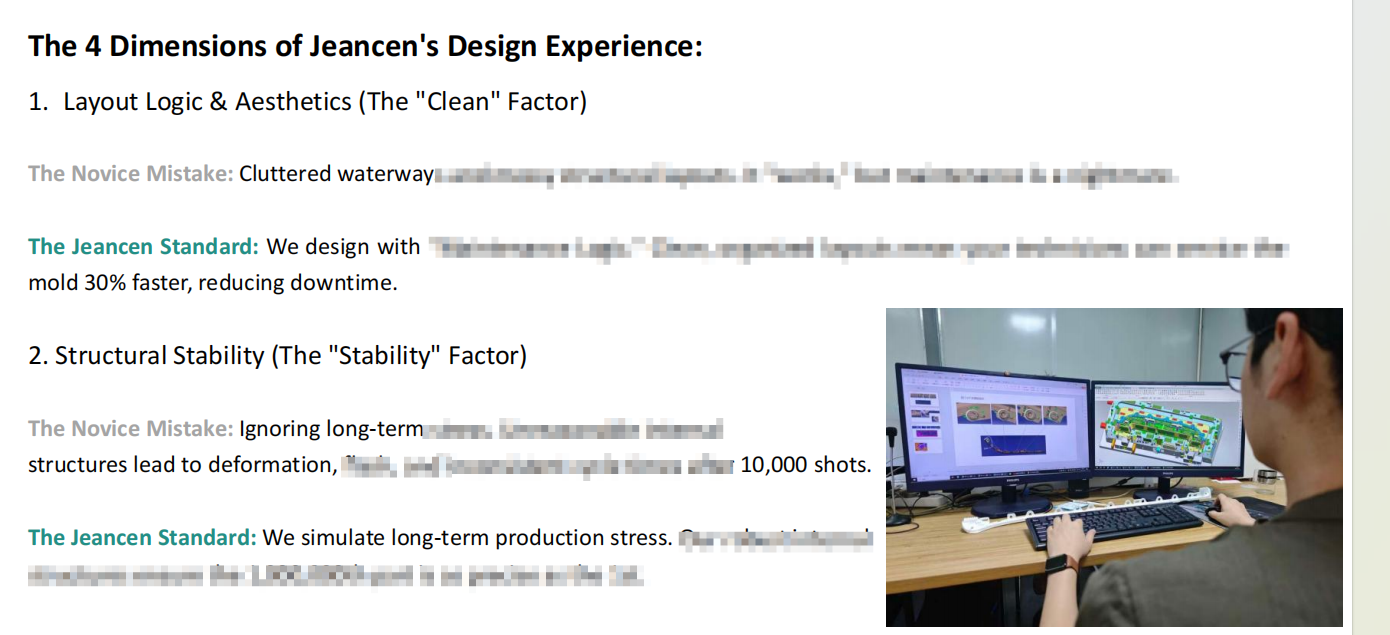
Here is a fact about Jeancen that you won't find on many spec sheets: You cannot touch a CAD mouse at Jeancen until you have held a polishing stone.
Our engineering team has over 12 years of design experience, but more importantly, every single one of our senior designers spent their first 1-2 years on the shop floor as a Mold Fitter (Bench Worker).
Why does this matter?
- Pure "office designers" draw waterways that look neat on a screen but are impossible to reach during maintenance.
- "Fitter-Turned-Designers" know the frustration of trying to assemble a poorly designed slide mechanism.
We design with "Maintenance Empathy." We ask: "If the technician needs to change a seal in 2 years, will they curse the designer, or thank him?"
Because we have been that technician, we ensure your team can service the mold 30% faster, directly increasing your uptime.
2. Structural Stability: Predicting the Future
Steel fatigues. Pressure deforms. This is physics.
A common issue I see in transfer molds is internal structures that are too weak to withstand high-pressure injection over time. They work fine during T1 trials, but after 50,000 cycles, you start seeing flash and dimensional instability.
- The Reality: A "cheap" design ignores long-term stress to save on machining time.
- The Jeancen Standard: We simulate long-term production stress before cutting steel. We ensure the internal support pillars are robust enough so that the 1,000,000th part is as precise as the 1st.
3. Design for Tooling (The Process Factor)
Designers who don't understand machining create expensive problems. If a feature is designed without considering CNC or EDM feasibility, it leads to weak steel conditions or unnecessarily slow processing.
Because our designers have hands-on experience with mold assembly and spotting, they design features that are friendly to the manufacturing process. This results in better steel integrity and a more robust tool structure.
4. The TCO Equation: Why "Cheap" is Expensive
Let’s go back to the client I mentioned at the start.
If you save $2,000 on a mold specifically because the supplier skipped the detailed cooling analysis or structural reinforcement, you are likely to pay **$20,000** later in:
- Slower cycle times (due to poor cooling).
- Frequent downtime (due to difficult maintenance).
- Early mold failure.
At Jeancen, we adhere to a simple philosophy: We invest 20% more effort upfront in design to save you 50% in backend headaches.
Conclusion: Engineering Certainty
We don't just sell steel; we sell the certainty that your production will run smoothly.
When our engineers ask detailed questions about your press parameters, it's not too difficult. It's because they have stood by the machine, they have fit the mold, and they know what it takes to guarantee success.
Don't let a "cheap" design become your most expensive lesson.
(Call to Action) Do you have a project where reliability is critical? Let's discuss your design feasibility. [Button: Contact Jeancen Engineering Team]